Last week at the Turkish Market, I walked by one of the spice stalls and noticed a small sign in front of the cashier: "Real Saffron from Iran. Available only while supplies last. Half gram, €3."
I didn't know what I would use it for, but I'd never seen saffron for sale before. I couldn't pass up the chance to try it. Walking up to the stall owner, I said "I'll take half a gram of Saffron, please."
This is when things got a little weird. The man's expression turned wary. "3 Euros," he replied quietly. Glancing nervously from side to side, he reached into a small compartment hidden behind his table. He fumbled for a moment, still looking around, and finally handed me a small, circular, plastic case containing a small pile of delicate red tendrils. I payed, thanked him, pocketed the saffron, and walked away.
I turned to my friend. "Did you see that? Saffron is legal, right? Why do I feel like I was just part of a drug deal?" 
I still haven't decided what to use the saffron for, but as I was researching some possibilities, I found myself reading about Moroccan style cooking. The following recipe is probably not precisely authentic, but the blend of eggplant, lemon, cumin and cinnamon is a Moroccan-inspired treat for the senses.
Moroccan Spiced Chicken and Eggplant
It isn't in the photo, but this pairs wonderfully with a side dish of roasted eggplant. Roast the eggplant in the oven while the chicken cooks, then add it to the pan a few minutes before serving to absorb the flavors.
For each serving you will need:
1-2 chicken pieces
1/2 - 1 small eggplant
1 medium onion
Juice from 1/2 a lemon (about 1.5 Tbs)
Seasoning Blend (per serving):
2 tsp. cumin
1/2 tsp. cinnamon
1/2 tsp. pepper
1/2 tsp. salt
Preparation:
Rub both sides of each chicken piece with the seasoning blend. You won't use all of it at this point, but season the chicken liberally. You can do this with the skin on, or remove it. I like to remove most of the skin, but leave a little bit around the edges for flavoring. Let the chicken sit for about 10 minutes so the spices have a chance to absorb.
While the chicken is resting, turn your broiler on. Cut the eggplant(s) in half, and remove the stems. Put the eggplant cut-side-down on a baking sheet under the broiler. You'll leave it around 10-15 minutes, until the skin is puckered and wrinkly, and the eggplant is soft.
Cooking the Chicken:
As the eggplant cooks, heat a frying pan over high heat. When a few drops of water sprinkled in the pan sizzle, it's ready. Add the chicken pieces, skin side down, and brown them. As they brown, thinly slice the onion(s).
Sprinkle about half of your remaining seasoning blend into the pan, and add the onion. Stir briefly. Juice the lemon(s), and drizzle the juice evenly over the chicken and onions. Cover the pan immediately to retain moisture, and turn the heat down to medium.
Adding the Eggplant:
Check on the eggplant. When the skin is wrinkly, pull it out from under the broiler. Let it cool briefly, then peel the skin off. It should have separated from the flesh and will pull away quite easily. Throw the skin away, and cut the eggplant into small chunks.
Add the eggplant to the chicken and onions. Stir briefly, and flip the chicken pieces for even cooking. Cover the pan again, and continue cooking until chicken is well-done. Stir occasionally to prevent sticking.
To serve:
Before serving, taste the eggplant mixture and add more of the seasoning blend if desired. Serve 1-2 pieces of chicken per person, with the eggplant as a side dish.
Continue Reading!
25 February, 2008
Simple Moroccan Spiced Chicken and Eggplant
Labels: chicken, eggplant, gluten free, meal, Moroccan, recipe, saffron, sommersize, vegetables
12 February, 2008
The Celery Blues
I'm generally known for having a penchant for odd vegetables. Some of my friends appreciate this, but there are others who run screaming every time I suggest making Brussels sprouts, kohlrabi, or whatever else happens to be on the menu. Which is why I find the following conversation even more amusing than it would otherwise be:
I'm standing in my friend's kitchen. I've just pulled a celery stalk from the bunch I purchased moments before at the supermarket. I'm pretty excited, because I haven't seen a celery bunch in many months. Living in California, the land of year round greens, I never realized that celery is a highly seasonal vegetable in other parts of the world.
Me: (crunch. crunch.)
Friend: What are you eating?
Me: Celery.
Friend: Celery? I don't think I've ever seen that before.
Me: Really? I know I can't find it very often, but you've never had it before? Here, try a piece.
Friend (crunching thoughtfully): Ugh! It's so bitter! It's even more bitter than celery root!
Me: Well, yeah, but... it's crunchy. And, um, it's not really that bitter. I mean... it's sort of salty and tangy, too.
Friend: Are you sure you're supposed to eat it raw?
Me: Of course! This is a totally normal American snack food. You should try it with cream cheese. Or peanut butter! (pause) Oh, man, I wish I had some peanut butter.
Friend: You eat that with peanut butter? Really?? God, you Americans eat some strange things.
Upon further consideration, I understand why it isn't a very popular vegetable over here. All the celery I've encountered thus far has been painfully sub-par. The stalks are somehow the wrong density; they end up too watery and stringy, and they're more tough than crunchy.
The flavor is there. It still works as a soup additive. But I really can't blame anyone for not wanting it on their veggie platter.
Continue Reading!
Labels: celery, stories, vegetables
10 February, 2008
White Chocolate Hazelnut Cake

A friend of mine collects bath products. Not just bath products, but bath products scented like food. A quick glance in her shower finds things like "Moisturizing Maple Syrup Scrub," "Pecan Pie Body Wash," and "Vanilla Butter Cream Body Frosting." They smell astonishingly close to the real thing. Mouth-wateringly so. I've been known to occasionally sniff my way through her shower shelves in lieu of dessert.
A few weeks ago I noticed a bottle titled "White Chocolate Hazelnut Cake," by the company Philosophy. Not only did this one smell delicious, but the italicized script covering the front of the bottle turned out to be a recipe! And not only was there a recipe, but it called for breadcrumbs, which I had made just the day before. Clearly this was meant to be.
I wasn't completely sure if the recipe was intended for actual cooking purposes, or just for decoration, but it looked workable. I just needed an excuse to bake a cake.
Last weekend, we had a small dinner party, and I finally had my chance. I creamed, whipped, beat, and folded; then popped it all in the oven and hoped for the best.
It was amazing. A sprinkling of cinnamon lent a flavor akin to carrot cake, but the texture was of a class all its own. It was tender and moist; airy with beaten egg whites, rich with yolks and white chocolate. The coarse breadcrumbs I used gave it an unusual, but wonderful, mouth feel. I'm not normally a "sweets" person - but somehow the 5 of us managed to polish off the entire 9" cake in a matter of minutes.
White Chocolate Hazelnut Cake
adapted from Philosophy's recipe
Since the egg whites are so important to the texture of this cake,
I highly recommend this wonderful writeup on proper whipping
and folding technique.
6 ounces white chocolate, coarsely chopped
2/3 cup sugar
3/4 cup butter
8 eggs, separated
2/3 cup bread crumbs (gluten-free, if need be)
1/3 cup ground hazelnuts
1 tsp. ground cinnamon
1/2 tsp. salt
Preheat oven to 350° F
Butter a 9" Springform pan, and lay a circle of baking paper on the bottom.
First, melt the white chocolate in a double boiler. Don't use the microwave for this - white chocolate scorches too easily.
Separate the eggs, putting the whites in a large mixing bowl. Make sure not even a touch of yolk gets in to the whites.
Combine hazelnuts, bread crumbs, cinnamon, and salt in a small bowl and mix well.
Cream the butter and 1/3 C. sugar in a large bowl until soft and fluffy. Add the melted white chocolate and mix well. Beat the yolks into the butter, one at a time; continue beating until the mass is smooth and creamy. Stir the hazelnut-breadcrumb mixture into the butter and eggs, and mix thoroughly.
Measure the remaining 1/3 C. sugar and have it ready.
Beat the egg whites until soft peaks form. While beating, slowly pour the sugar into the whites. Continue beating until the peaks become stiff.
Stir about 1/4 of the egg whites into the batter, then gently fold in the remainder.
Pour the batter into your prepared pan, and bake for 45 min.
White Chocolate Glaze
Prepare this after cake is cooled
8 oz. white chocolate
1/2 c. heavy whipping cream
1 pinch sea salt
Chop the white chocolate into small pieces, and dump into a medium-sized bowl.
Heat the cream in a small saucepan just until bubbles form at the edges. Quickly pour the hot cream over the chocolate. Leave it to melt for about 1 minute, then add salt and stir until smooth. Let it cool slightly, but make sure it remains liquid.
To Assemble:
When cake is cooled, remove the sides from the springform. If there is a raised edge along the outside of the cake, trim it away. Turn the cake out onto a serving dish, bottom-side up.
Pour the warm glaze over the cake, letting it drip down the sides. Sprinkle with chopped hazelnuts for garnish.
Continue Reading!
Labels: cake, dessert, gluten free, recipe, sweets, white chocolate hazelnut
30 January, 2008
I Have Hope Again

Over Christmas, as I first started suspecting that my life-long allergies might be related to gluten, I tried my hand at a loaf of artisan-style gluten free bread. The recipe, from Gluten Free Girl, got rave reviews from her readers, and the photos were mouthwatering. I assumed that, with all my past baking experience, there was almost no way I could go wrong.
But alas, no. I might be able to bake wheat bread with one hand tied behind my back, but gluten-free is a different beast all together. On my first attempt, I added enough water to make the dough resemble a normal wheat dough. Turns out that wasn't enough. I ended up with a whole-grain, artisal-style brick.
Not easily deterred, I tried again with a wetter dough. And it was an improvement - but not by much. I couldn't blame the recipe - just that something in my technique was totally amiss.
When I got back to Berlin, the local organic market happened to be clearing out their 2007 stock of gluten-free products. I happily picked up a loaf of cornbread and two boxes of gluten-free bread mix. I was particularly skeptical of these being any better than what I'd made from scratch, but for 50% off I had to try.
A few nights ago, with an evening free, I suddenly had the urge to bake again. I pulled out my packaged mix, dumped it in a bowl, and read the instructions. After pouring in exactly the amount of water called for on the back of the box, I found myself looking at a bowl of... goop.
This was not bread dough as I know it. If this is what gluten-free dough looks like, I thought, no wonder my instincts led me astray on my first two tries.
Bread dough should be a creamy, silky mass - like pulled taffy, lightly dusted with flour. This was a mass, yes, but more in the sense of glob.
"Kneading" a gluten-free bread is like squelching through mud in your bare feet. The thrill of watching the dough's metamorphosis from sticky to smooth is utterly missing. But I kept it up for the requisite 6 minutes, and put the bread in a warm spot to rise for the next hour.
60 minutes later, I was surprised to find that the dough had actually grown. The yeast was working! The wet, gloppy batter was soft enough to bubble and grow, even without the support of gluten. I left it for a second rising, put it in the oven and began, tentatively, to hope for a loaf of real bread.
The scent of warm yeast filled the apartment. After 60 minutes of longingly sniffing the air, I opened the oven door and peeked inside. A beautiful, golden-brown crust looked back at me. I pulled the loaf out and, unable to wait, cut a wedge straight from the pan. Blowing on it just long enough to avoid third-degree burns, I popped it in my mouth.
Buttery. Delicious. Fluffy, with just the right chewiness. I had baked bread again! It was all I could do to keep from devouring half the loaf right then. Somehow I refrained... until breakfast the following morning.
What was left after that, I shredded into breadcrumbs and froze. I had no particular plan for them, but only days later I found a cake recipe calling for breadcrumbs. More on that next week.
Now I'm determined to try for a gluten-free sourdough bread. And the dense, wholegrain Schwarzbrot that is so common here seems like it would lend itself perfectly to a gluten-free recipe. I have to order some different types of flour by mail, but I can't wait to get started.
Continue Reading!
Labels: bread, gluten free
23 January, 2008
Turkish Market

Every Tuesday and Friday, I peer out my window and watch one of Berlin's more unusual cultural events unfold. The Maybachufer Market, which locals lovingly call the "Turkish Market," is like stepping into an open air bazaar in the heart of Istanbul.
Twice a week - come rain, shine, or snow - a whole city block is packed with stalls offering vegetables, fruit, fish, cheese, housewares, fabrics, and loaves of fluffy flatbread strewn with sesame seeds. Tourists and locals alike crowd together, the babble of voices blending with the sharp calls of touts hawking their wares. "3 Kilo, 1 Euro! Drei Kilo, ein Euro! Bitte schön, bitte schön, bitte schön!" they trill, thick accents harmoniously rolling the "r".
Sliced fruit samples lay waiting, as shoppers snack their way along. An incongruous mix of humanity bumps together along the cobblestones: devout Turkish grandmothers, draped in black robes and headscarves, drag their unwilling shopping dollies behind them; tourist clutch their bags as dreadlocked 20-somethings with skull-print leggings try impatiently to squeeze by.
This market is quintessentially Berlin, and all summer long I made a point of meandering my way through at least once a week. I frequently came away without a single carrot; the atmosphere and the texture of fabric bolts beneath my hands was enough to satisfy me.
This winter something has changed. The biting cold air sucks some of the festivity from the crowd. People aren't there to meander now. With breath freezing in the air and overflowing bags dangling heavily from chilled hands, we walk quickly, looking forward to the warmth of our apartments. But despite the cold, I head to the market nearly every week. And now I never come home empty handed.
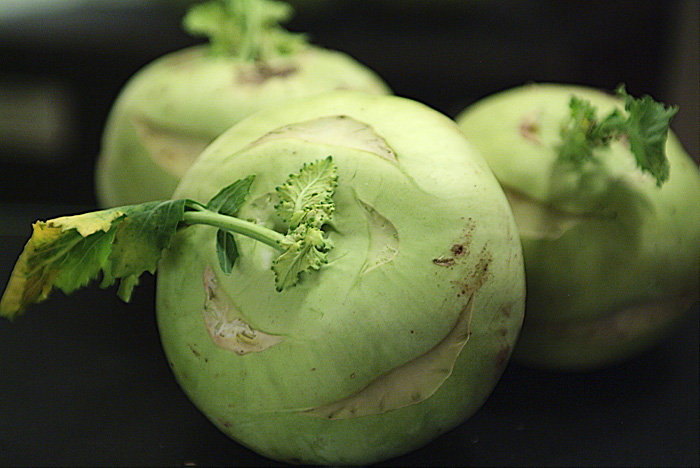
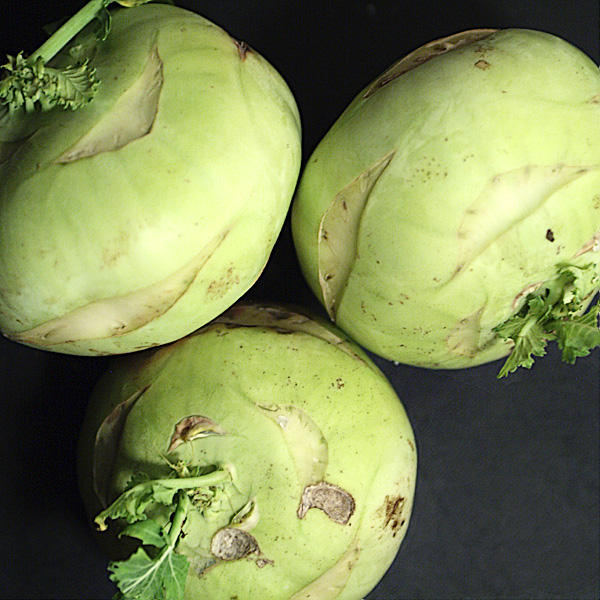
This winter, walking along with my scarf snug around my neck and my hands shoved deep in my pockets, I discovered root vegetables. Not just the potatoes, yams, and carrots I'd known in southern California; but new, unfamiliar beasts of the vegetable kingdom. Something in the frigid air peaked my curiosity about the piles of knobby, dirt-encrusted celery root; glowingly-white daikon; and crisp, green kohlrabi that all so recently appeared in the market stalls.
I tried the kohlrabi first, with a bit of trepidation. I had no idea what I would do with it when I got it home. But for 30 cents a piece, I figured I couldn't go too wrong. I chose three friendly-looking specimens, placed a Euro in the gloved hand of the stall owner, and headed off with my prize.
A quick Google search later, and I realized I'd stumbled onto a horticultural gem. Kohlrabe (which is actually a stem, not a root as I'd first thought) is like a mad scientist's cross between a green apple and a baby potato. Left raw, it keeps its fruity characteristics; steamed, sautéed, creamed, or baked it shows more of its vegetable nature. I've tried most of these options by now. I can't get enough of it.
I've had it raw with slices of cheese. Shaved it paper thin and sautéed it with Parmesan. I've cut it into matchsticks, smothered it in spaghetti sauce,chopped it raw into tuna salad.
Tonight, it was oven-baked kohlrabi "fries".
Warm, flavorful, and delicious, they have the dense chewy goodness of a potato with none of the starchy sleepiness. And an average-size kohlrabi has twice as much Vitamin C as an orange! I can't wait to keep playing with these - I think kohlrabi hash browns with eggs is definitely on the menu this weekend.
Kohlrabi Oven Fries:
Use about 1 kohlrabi per serving.
1. Preheat the oven to 400 °F (200 °C)
2. Peel the tough green skin from the kohlrabi, and discard it.
3.Cut each kohlrabi in half, then slice about 1/8 in. thick. Place slices in a large bowl.
3. Sprinkle your "fries" lightly with olive oil, stirring until evenly coated. If you have an oil mister, this is a great time to use it.
4. Lay the slices in a single layer on a metal baking pan, and sprinkle with your favorite French fry seasonings. I used salt, pepper, garlic, and paprika.
5. Bake 15-20 min, until browned on top and soft all the way through.
Continue Reading!
Labels: gluten free, kohlrabi, recipe, sommersize, Turkish market, vegetables