I've always been one to experiment with colors. I think they improve everything. Growing up with white walls in our house, I pleaded for yellow. Born with brown hair, I've dyed it every color under the rainbow. And I've been known to experiment with the color of my food on more than one occasion.
When I was a kid, I loved the Dr. Seuss book Green Eggs and Ham. Not just liked, but loved. Obsessively, perhaps. I know I convinced my dad, more than a few times, to dye my scrambled eggs green, and I remember being disappointed that there was no was to pull it off with poached eggs.
There's another instance that comes to mind, as well. When I was 8 or 9 years old, my mom had the flu, and my dad and I cooked dinner for her. I don't remember the whole menu, but I know for sure mashed potatoes and gravy were part of the feast.
You might be asking yourself right now, why I still remember this particular instance of mashed-potato making. Well, that would be because, once again, I decided to play with colors. I wanted to make the potatoes more festive, to cheer my mom up and help her feel better.
If you were sick in bed with the flu, wouldn't you want a heaping serving of turquoise mashed potatoes with purple gravy? (Sorry, Mom!)
At any rate, given my long history with oddly colored foods, you can imagine my excitement when I stumbled onto my latest and greatest discovery at the Turkish market. Purple potatoes!
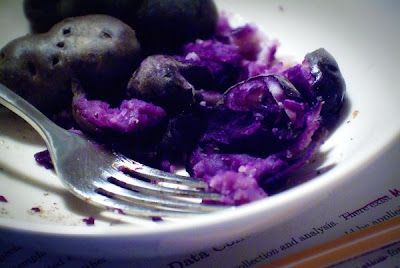
I actually didn't realize quite what I'd gotten into when I bought them. I thought they just had deep purple skins. It wasn't until I boiled them up one night for dinner that I realized what a gem I had found. Digging in with my fork, I expected the sharp contrast of purple skin with white potato flesh - but there, instead, was this bright violet, the color of springtime flowers!
I never knew such a potato existed. They're exquisitely colored, creamy tasting, and mildly sweet. And I've read that they contain a higher level of anti-oxidants, as well. Great flavor with extra nutrition, to boot!
I ate them with a sprinkling of garlic and salt, but if I'd known beforehand what I was getting into, I would have tried a sprinkling of walnuts and maybe a dash of cardamom.
These would make a spectacular potato salad as well, with or without regular potatoes. Rather than the usual heavy mayonnaise dressing, I'd like to try a salad with some walnuts, shallots, rice vinegar, and parsley for starters. Let this sweet and unusual potatoes shine through, complemented by the seasonings - but don't drown them like you would an ordinary white potato.
I don't know how easy or difficult these might be to find in the States, but I'd have to imagine someplace like Whole Foods would likely carry them. If you do stumble across them, let me know, because I'll be back visiting for Thanksgiving and I'd love to have some at dinner!
Continue Reading!
22 October, 2008
Purple Potatoes
Labels: potatoes, purple potatoes, side dish, vegetables, vegetarian
25 February, 2008
Simple Moroccan Spiced Chicken and Eggplant

Last week at the Turkish Market, I walked by one of the spice stalls and noticed a small sign in front of the cashier: "Real Saffron from Iran. Available only while supplies last. Half gram, €3."
I didn't know what I would use it for, but I'd never seen saffron for sale before. I couldn't pass up the chance to try it. Walking up to the stall owner, I said "I'll take half a gram of Saffron, please."
This is when things got a little weird. The man's expression turned wary. "3 Euros," he replied quietly. Glancing nervously from side to side, he reached into a small compartment hidden behind his table. He fumbled for a moment, still looking around, and finally handed me a small, circular, plastic case containing a small pile of delicate red tendrils. I payed, thanked him, pocketed the saffron, and walked away.
I turned to my friend. "Did you see that? Saffron is legal, right? Why do I feel like I was just part of a drug deal?" 
I still haven't decided what to use the saffron for, but as I was researching some possibilities, I found myself reading about Moroccan style cooking. The following recipe is probably not precisely authentic, but the blend of eggplant, lemon, cumin and cinnamon is a Moroccan-inspired treat for the senses.
Moroccan Spiced Chicken and Eggplant
It isn't in the photo, but this pairs wonderfully with a side dish of roasted eggplant. Roast the eggplant in the oven while the chicken cooks, then add it to the pan a few minutes before serving to absorb the flavors.
For each serving you will need:
1-2 chicken pieces
1/2 - 1 small eggplant
1 medium onion
Juice from 1/2 a lemon (about 1.5 Tbs)
Seasoning Blend (per serving):
2 tsp. cumin
1/2 tsp. cinnamon
1/2 tsp. pepper
1/2 tsp. salt
Preparation:
Rub both sides of each chicken piece with the seasoning blend. You won't use all of it at this point, but season the chicken liberally. You can do this with the skin on, or remove it. I like to remove most of the skin, but leave a little bit around the edges for flavoring. Let the chicken sit for about 10 minutes so the spices have a chance to absorb.
While the chicken is resting, turn your broiler on. Cut the eggplant(s) in half, and remove the stems. Put the eggplant cut-side-down on a baking sheet under the broiler. You'll leave it around 10-15 minutes, until the skin is puckered and wrinkly, and the eggplant is soft.
Cooking the Chicken:
As the eggplant cooks, heat a frying pan over high heat. When a few drops of water sprinkled in the pan sizzle, it's ready. Add the chicken pieces, skin side down, and brown them. As they brown, thinly slice the onion(s).
Sprinkle about half of your remaining seasoning blend into the pan, and add the onion. Stir briefly. Juice the lemon(s), and drizzle the juice evenly over the chicken and onions. Cover the pan immediately to retain moisture, and turn the heat down to medium.
Adding the Eggplant:
Check on the eggplant. When the skin is wrinkly, pull it out from under the broiler. Let it cool briefly, then peel the skin off. It should have separated from the flesh and will pull away quite easily. Throw the skin away, and cut the eggplant into small chunks.
Add the eggplant to the chicken and onions. Stir briefly, and flip the chicken pieces for even cooking. Cover the pan again, and continue cooking until chicken is well-done. Stir occasionally to prevent sticking.
To serve:
Before serving, taste the eggplant mixture and add more of the seasoning blend if desired. Serve 1-2 pieces of chicken per person, with the eggplant as a side dish.
Continue Reading!
Labels: chicken, eggplant, gluten free, meal, Moroccan, recipe, saffron, sommersize, vegetables
12 February, 2008
The Celery Blues
I'm generally known for having a penchant for odd vegetables. Some of my friends appreciate this, but there are others who run screaming every time I suggest making Brussels sprouts, kohlrabi, or whatever else happens to be on the menu. Which is why I find the following conversation even more amusing than it would otherwise be:
I'm standing in my friend's kitchen. I've just pulled a celery stalk from the bunch I purchased moments before at the supermarket. I'm pretty excited, because I haven't seen a celery bunch in many months. Living in California, the land of year round greens, I never realized that celery is a highly seasonal vegetable in other parts of the world.
Me: (crunch. crunch.)
Friend: What are you eating?
Me: Celery.
Friend: Celery? I don't think I've ever seen that before.
Me: Really? I know I can't find it very often, but you've never had it before? Here, try a piece.
Friend (crunching thoughtfully): Ugh! It's so bitter! It's even more bitter than celery root!
Me: Well, yeah, but... it's crunchy. And, um, it's not really that bitter. I mean... it's sort of salty and tangy, too.
Friend: Are you sure you're supposed to eat it raw?
Me: Of course! This is a totally normal American snack food. You should try it with cream cheese. Or peanut butter! (pause) Oh, man, I wish I had some peanut butter.
Friend: You eat that with peanut butter? Really?? God, you Americans eat some strange things.
Upon further consideration, I understand why it isn't a very popular vegetable over here. All the celery I've encountered thus far has been painfully sub-par. The stalks are somehow the wrong density; they end up too watery and stringy, and they're more tough than crunchy.
The flavor is there. It still works as a soup additive. But I really can't blame anyone for not wanting it on their veggie platter.
Continue Reading!
Labels: celery, stories, vegetables
23 January, 2008
Turkish Market

Every Tuesday and Friday, I peer out my window and watch one of Berlin's more unusual cultural events unfold. The Maybachufer Market, which locals lovingly call the "Turkish Market," is like stepping into an open air bazaar in the heart of Istanbul.
Twice a week - come rain, shine, or snow - a whole city block is packed with stalls offering vegetables, fruit, fish, cheese, housewares, fabrics, and loaves of fluffy flatbread strewn with sesame seeds. Tourists and locals alike crowd together, the babble of voices blending with the sharp calls of touts hawking their wares. "3 Kilo, 1 Euro! Drei Kilo, ein Euro! Bitte schön, bitte schön, bitte schön!" they trill, thick accents harmoniously rolling the "r".
Sliced fruit samples lay waiting, as shoppers snack their way along. An incongruous mix of humanity bumps together along the cobblestones: devout Turkish grandmothers, draped in black robes and headscarves, drag their unwilling shopping dollies behind them; tourist clutch their bags as dreadlocked 20-somethings with skull-print leggings try impatiently to squeeze by.
This market is quintessentially Berlin, and all summer long I made a point of meandering my way through at least once a week. I frequently came away without a single carrot; the atmosphere and the texture of fabric bolts beneath my hands was enough to satisfy me.
This winter something has changed. The biting cold air sucks some of the festivity from the crowd. People aren't there to meander now. With breath freezing in the air and overflowing bags dangling heavily from chilled hands, we walk quickly, looking forward to the warmth of our apartments. But despite the cold, I head to the market nearly every week. And now I never come home empty handed.
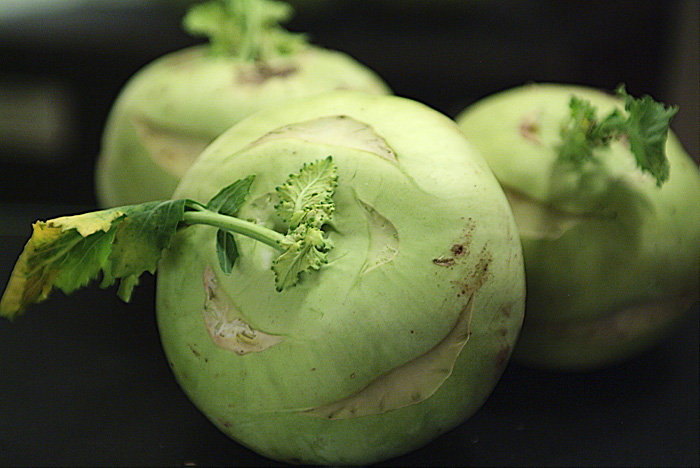
This winter, walking along with my scarf snug around my neck and my hands shoved deep in my pockets, I discovered root vegetables. Not just the potatoes, yams, and carrots I'd known in southern California; but new, unfamiliar beasts of the vegetable kingdom. Something in the frigid air peaked my curiosity about the piles of knobby, dirt-encrusted celery root; glowingly-white daikon; and crisp, green kohlrabi that all so recently appeared in the market stalls.
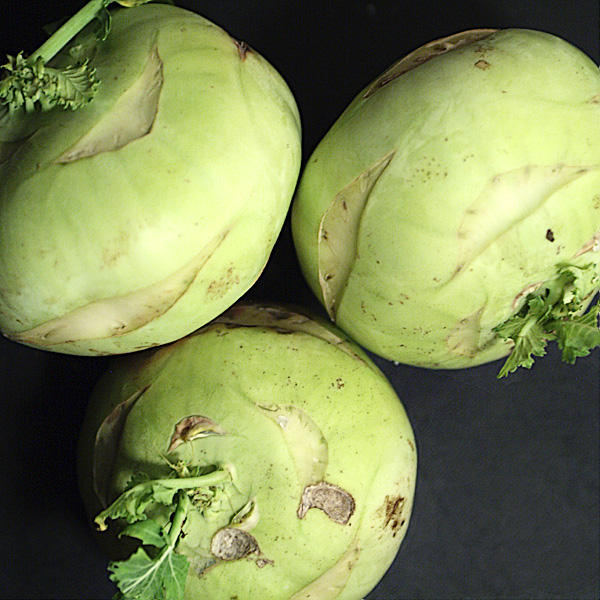
I tried the kohlrabi first, with a bit of trepidation. I had no idea what I would do with it when I got it home. But for 30 cents a piece, I figured I couldn't go too wrong. I chose three friendly-looking specimens, placed a Euro in the gloved hand of the stall owner, and headed off with my prize.
A quick Google search later, and I realized I'd stumbled onto a horticultural gem. Kohlrabe (which is actually a stem, not a root as I'd first thought) is like a mad scientist's cross between a green apple and a baby potato. Left raw, it keeps its fruity characteristics; steamed, sautéed, creamed, or baked it shows more of its vegetable nature. I've tried most of these options by now. I can't get enough of it.
I've had it raw with slices of cheese. Shaved it paper thin and sautéed it with Parmesan. I've cut it into matchsticks, smothered it in spaghetti sauce,chopped it raw into tuna salad.
Tonight, it was oven-baked kohlrabi "fries".
Warm, flavorful, and delicious, they have the dense chewy goodness of a potato with none of the starchy sleepiness. And an average-size kohlrabi has twice as much Vitamin C as an orange! I can't wait to keep playing with these - I think kohlrabi hash browns with eggs is definitely on the menu this weekend.
Kohlrabi Oven Fries:
Use about 1 kohlrabi per serving.
1. Preheat the oven to 400 °F (200 °C)
2. Peel the tough green skin from the kohlrabi, and discard it.
3.Cut each kohlrabi in half, then slice about 1/8 in. thick. Place slices in a large bowl.
3. Sprinkle your "fries" lightly with olive oil, stirring until evenly coated. If you have an oil mister, this is a great time to use it.
4. Lay the slices in a single layer on a metal baking pan, and sprinkle with your favorite French fry seasonings. I used salt, pepper, garlic, and paprika.
5. Bake 15-20 min, until browned on top and soft all the way through.
Continue Reading!
Labels: gluten free, kohlrabi, recipe, sommersize, Turkish market, vegetables